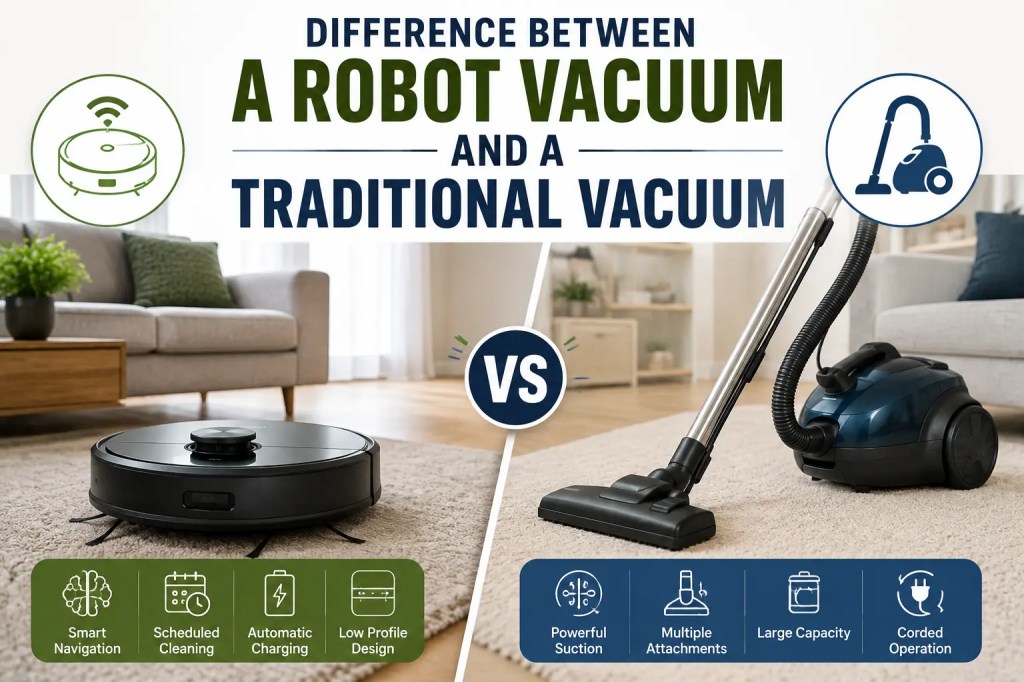
The core difference comes down to autonomy versus power. Robot vacuums clean on their own, on a schedule, with modest suction. Traditional vacuums need a person pushing them but deliver noticeably stronger cleaning performance. Neither one requires home appliances repair expertise to choose correctly, just an honest look at how your home actually gets dirty and how much involvement you want in the process.
How Each One Actually Cleans
A robot vacuum navigates a room using onboard sensors, cameras, or laser mapping, moving in patterns designed to cover as much floor as possible without a person directing it. It runs on a rechargeable battery, docks itself to recharge, and can be scheduled to clean daily without anyone touching it, one of the few areas of home appliances repair and maintenance that’s largely automated by design.
A traditional vacuum, whether upright, canister, or cordless stick, relies entirely on a person pushing or guiding it, adjusting settings for different surfaces, and manually working it into corners and under furniture as needed. What it lacks in independence, it makes up for in raw suction power and consistent contact pressure against carpet fibers.
Suction Power Isn’t Close
This is the single biggest practical difference. Traditional vacuums, particularly uprights and canisters, generate substantially more suction than robot vacuums, which are constrained by battery size and a compact motor that has to fit inside a low profile disc. On thick carpet or heavily soiled areas, that suction gap becomes obvious fast.
Robot vacuums handle daily maintenance on hard floors and light carpet well. They struggle noticeably more with deep pile carpet, large debris, or genuinely dirty floors that require real agitation and airflow to clean properly.
Coverage and Accessibility
Robot vacuums can’t climb stairs, full stop, which means multi level homes need a separate solution for anything beyond the floor the robot lives on. They also struggle with loose cables, low furniture clearance, and cluttered floors, sometimes getting stuck or simply avoiding areas a person would have no trouble reaching with a hose attachment.
Traditional vacuums go wherever you take them, stairs included, and attachments extend their reach into upholstery, curtains, and tight corners that a robot vacuum’s fixed low profile design can’t access at all.
Time and Effort
This is where robot vacuums genuinely win. Once set up and scheduled, a robot vacuum cleans without anyone lifting a finger, which adds up to real time saved over weeks and months, particularly in households where daily floor maintenance would otherwise get skipped entirely.
Traditional vacuums require someone to set aside time, pull the machine out, and actually run it, which for busy households often means floors get cleaned less frequently than they’d like, even with a perfectly good vacuum sitting in the closet.
Maintenance Differences
Robot vacuums need their own upkeep. Brushes and sensors need regular cleaning, the battery degrades over years and eventually needs replacing, and dust bins are typically much smaller, requiring more frequent emptying than a traditional vacuum’s larger canister or bag.
Traditional vacuums need filter cleaning, bin emptying, brush roll maintenance, and occasional belt replacement, generally on a less frequent basis than a robot vacuum’s smaller components, but each individual maintenance task tends to take a bit more hands on effort.
Price Comparison
Entry level robot vacuums start relatively affordable, but genuinely capable models with strong mapping and decent suction climb toward the price of a mid range traditional vacuum, sometimes well past it for premium self emptying models. Traditional vacuums span an equally wide range, from budget uprights to premium canister and stick models, so price alone isn’t a reliable way to pick between the two categories; comparing features and expected suction matters far more than the number on the box.
Which One Should You Choose?
Robot vacuums suit households with mostly hard floors or low pile carpet, minimal stairs, and a preference for hands off, scheduled maintenance over deep, thorough cleaning. Traditional vacuums suit households with thicker carpet, multiple floors, pets that shed heavily, or anyone who wants the strongest possible clean rather than convenient upkeep.
Why Many Households Choose Both
A growing number of people don’t pick one over the other, they use a robot vacuum for daily maintenance and a traditional vacuum for a deeper weekly clean. This combination covers more ground than either type manages alone, without asking one machine to be everything at once, and it often reduces how often either one needs home appliances repair attention, since neither is being pushed beyond what it’s actually built for.
Summary
Robot vacuums offer convenience and consistent daily maintenance with modest suction, while traditional vacuums deliver stronger cleaning power at the cost of needing a person to run them. Neither is objectively better, and the right choice, or combination, depends on your flooring, home layout, and how much hands on involvement you actually want. Appliances Repair Blog covers maintenance and troubleshooting for both types, so whichever you choose, or however you combine them, home appliances repair guidance is here when something needs attention.


Leave a Reply