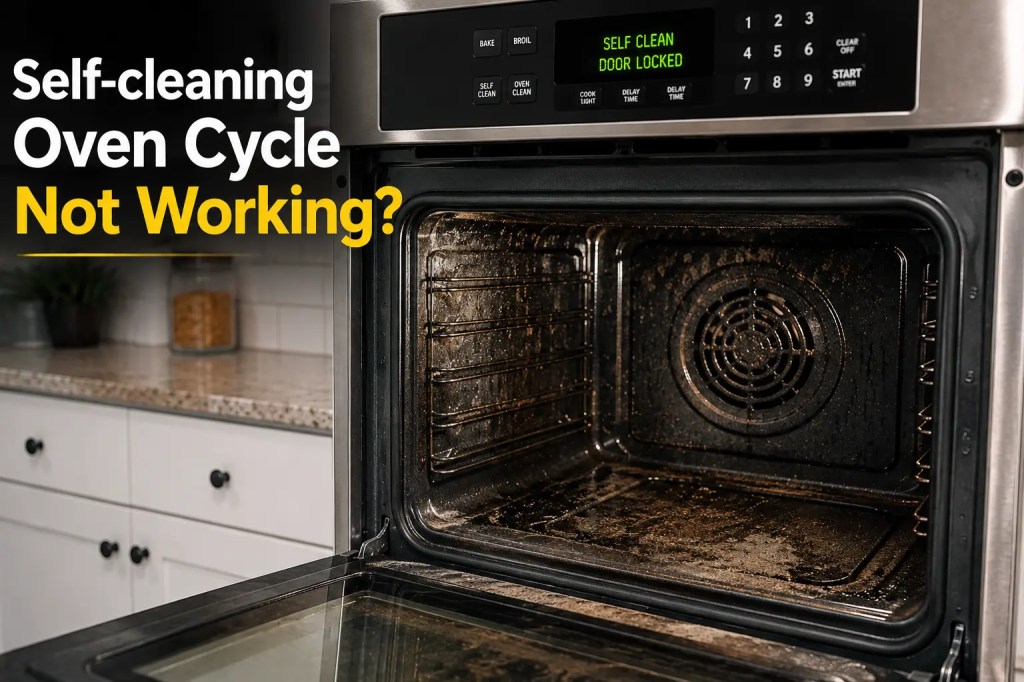
A self-cleaning cycle that won’t start, won’t finish, or won’t lock is almost always tied to one of a handful of causes: a door that isn’t fully closed, a failed door lock mechanism, a control board glitch, or a genuine safety lockout triggered by overheating. Here’s how to work through each possibility.
The Cycle Won’t Start At All
Most ovens require the door to be completely closed and, on many models, the door lock engaged before the self-cleaning cycle will even begin. If the door isn’t shutting flush, something as simple as a rack left in the wrong position or a small object caught in the door seal can prevent it from closing enough to satisfy the safety sensor.
Check for anything obstructing the door. Remove all racks unless your manual specifically says to leave one in. Make sure the door closes fully and evenly, with no visible gap on either side.
If the door closes fine but the cycle still won’t start, check that you’re selecting the mode correctly. Some ovens require pressing and holding a button, or selecting a cleaning duration before the cycle activates, and it’s easy to miss a step buried in a menu you don’t use often.
The Door Won’t Lock
Self-cleaning cycles run at extremely high temperatures, often 800 to 900 degrees Fahrenheit, which means the door lock is a genuine safety feature, not just a convenience. Ovens are designed to refuse to start the cycle if the lock mechanism doesn’t engage properly, since running that hot with an unsecured door poses a real risk.
A door lock that clicks but doesn’t fully engage, or doesn’t click at all, usually points to a worn or misaligned lock motor, a small motorized latch mechanism most ovens use for this specific function. This part can fail independently of everything else in the oven working normally.
Testing this yourself is limited since the lock mechanism is generally not something to bypass or force manually; doing so risks running the cycle without proper safety engagement. If the lock isn’t engaging, this is typically a job for a technician to diagnose and replace the correct part.
The Cycle Starts But Stops Partway Through
An oven that begins self-cleaning but shuts off before finishing is often protecting itself from an internal temperature that’s climbed higher than expected. This can happen if there’s an unusually large amount of grease or food debris inside, since burning that off produces smoke and heat beyond what the cycle anticipated for a normally maintained oven.
Wipe out loose crumbs, spills, and excess grease before running a self-clean cycle rather than relying on the cycle to handle everything from scratch. This single habit prevents a large share of interrupted cycles.
If the oven consistently shuts off early even with minimal debris inside, a failing temperature sensor may be reporting an inaccurate reading that triggers a premature safety shutoff, which points back to the same sensor issue that can also cause uneven regular baking.
Strong Odors or Smoke During the Cycle
Some smoke and odor during a first self-clean cycle, or one run after a long gap since the last cleaning, is normal, since the process is literally burning off baked-on residue at extreme heat. Persistent, heavy smoke well beyond the first few minutes, or a burning smell that seems electrical rather than food related, is different and worth stopping the cycle for.
Ventilate the kitchen well during any self-clean cycle regardless, since even a normal cycle produces noticeably more odor and smoke than regular cooking.
The Control Panel Shows an Error Code
Many ovens display a specific error code when the self-cleaning cycle fails to start or complete, often related to the door lock, temperature sensor, or control board. Check your manual for what the specific code means for your model, since codes and their meanings vary significantly between manufacturers.
In many cases, simply powering the oven off at the breaker for a minute or two and restarting it clears a temporary control board glitch, similar to restarting any other appliance with a built-in computer. If the same code reappears consistently, that points to an actual component failure rather than a temporary fault.
Should You Even Use the Self-Cleaning Cycle?
Worth mentioning: self-cleaning cycles put real thermal stress on an oven’s components, and some appliance technicians note that older ovens or those already showing minor issues can develop new problems after a high-heat cleaning cycle that a manual cleaning wouldn’t have caused. If your oven is older or has a history of electrical quirks, manually cleaning with a non-abrasive oven cleaner may be the lower-risk option.
When to Call a Professional
Door closure issues and light debris buildup are safe to check and address yourself. A lock mechanism that won’t engage, a control board that’s throwing persistent error codes, or a burning electrical smell all warrant a technician, since these involve components tied directly to a high-heat safety system that shouldn’t be worked around.
 Appliance Repair Blog
Leave a comment